


Read time: 4 to 5 minutes / SIA Group/ This article will help you understand general liability insurance in North Carolina and the Southeast. If you’re looking for guidance regarding general liability NC, you’re in the right place.
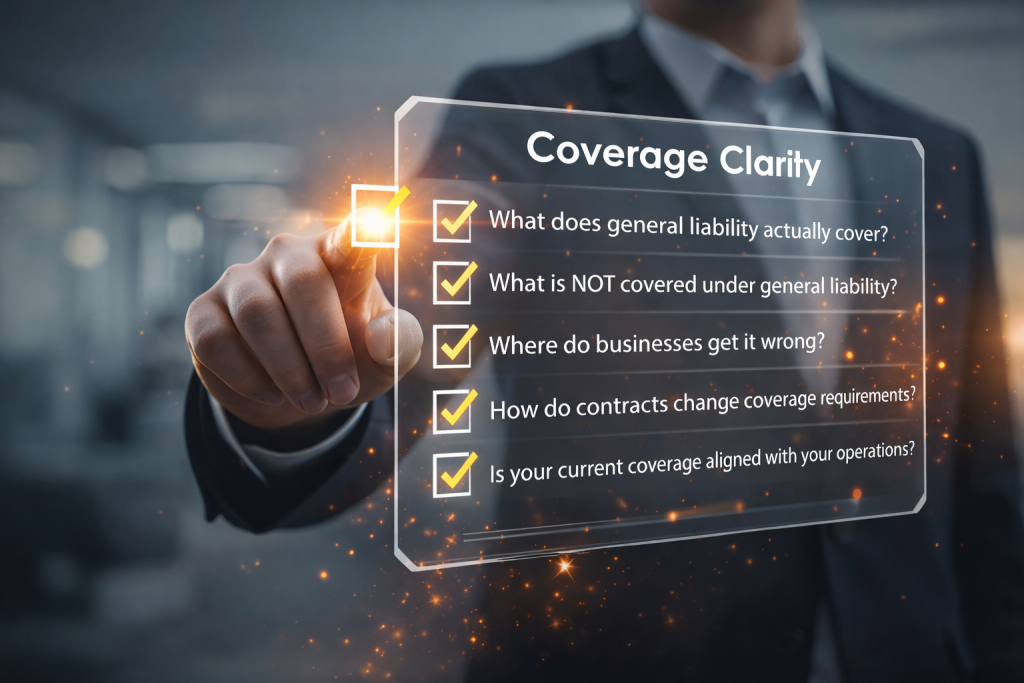
General liability is one of the most common policies businesses carry, but understanding general liability NC coverage is where most confusion begins.
It is also one of the most misunderstood.
Many businesses assume general liability covers anything that goes wrong. Others carry it because a contract requires it, without fully understanding what it actually does.
Across North Carolina and the Southeast, this misunderstanding often leads to gaps that only become visible when a claim occurs.
The issue is not whether a business has general liability.
The issue is whether the coverage aligns with how the business actually operates.
What General Liability NC Is Designed to Cover
At its core, general liability insurance is built to protect against third party claims.
This means claims involving someone outside of your business.
The most common coverage areas include:
Bodily Injury
If someone is injured as a result of your business operations, general liability may respond.
Examples include:
• A client slips and falls at your location
• A third party is injured on a job site
• Your work creates a condition that leads to injury
Property Damage
If your work causes damage to someone else’s property, this is typically addressed under general liability.
Examples include:
• Damage to a client’s property during a project
• A subcontractor’s work causing damage that traces back to your operation
• Accidental damage caused while performing services
Products and Completed Operations
This applies to claims that arise after work has been completed.
Examples include:
• A product that causes damage after being installed
• Completed work that later results in injury or property damage
For many businesses across North Carolina, Virginia, and South Carolina, this is one of the most important and often overlooked areas of coverage.
Personal and Advertising Injury
This includes claims related to:
• Libel or slander
• Copyright infringement
• Advertising related issues
While less common, this coverage can still be relevant depending on how a business markets itself.
What General Liability NC Does Not Cover
This is where most confusion happens.
General liability is not designed to cover everything.
Understanding what is excluded is just as important as understanding what is included.
Employee Injuries
General liability does not cover injuries to employees.
This falls under workers compensation.
If a business incorrectly assumes general liability will respond to employee injury, it creates a significant gap.
Professional Mistakes
If your business provides advice, design, consulting, or specialized services, general liability does not cover errors in that work.
This requires professional liability coverage.
This is especially important for service based businesses across the Southeast, where financial loss from professional error can be significant.
Damage to Your Own Work
General liability typically does not cover the cost to repair or replace your own faulty work.
It may cover resulting damage, but not the work itself.
For example:
If a contractor installs something incorrectly and it fails, the cost to fix the installation may not be covered.
Business Property
Damage to your own building, equipment, or materials is not covered under general liability.
This falls under property insurance.
Auto Related Incidents
Any claim involving a vehicle is excluded from general liability.
This must be covered under a commercial auto policy.
Where Businesses Misunderstand General Liability NC
The most common issue is not the policy itself.
It is the assumption of what the policy does.
Across North Carolina and the Southeast, common misunderstandings include:
• Assuming general liability covers all types of claims
• Believing coverage automatically meets contract requirements
• Not reviewing exclusions tied to specific operations
• Failing to update coverage as the business grows
In many cases, the policy responds exactly as written.
The problem is that expectations did not match the structure of the coverage.
How Contracts Change General Liability Requirements
General liability is often driven more by contracts than by internal decisions.
Contracts may require:
• Specific liability limits
• Additional insured endorsements
• Primary and non contributory wording
• Completed operations coverage
For businesses operating across North Carolina, Virginia, and South Carolina, these requirements can vary by project, client, and location.
A policy that meets one contract may not meet another.
How to Evaluate If Your Coverage Is Aligned
Instead of asking:
“Do we have general liability?”
A better question is:
“If a claim happens, how would this policy respond based on how we actually operate?”
To answer that, businesses should look at:
Operations
→ What work is being performed
Contracts
→ What is being required
Exposure
→ Where risk is created
Coverage
→ Whether the policy reflects all three
Why This Matters as Businesses Grow
As businesses expand, general liability exposure changes.
New services, larger projects, additional employees, and multi state operations all increase complexity.
Many businesses based in North Carolina operate across the Southeast, which introduces new contract requirements and higher expectations.
Without regular review, general liability coverage can fall out of alignment quickly.
Final Thought
General liability is a foundational policy.
But it is not a catch all solution.
Understanding both what it covers and what it does not is what allows businesses to build a coverage structure that actually works when it is needed.
Commercial Insurance Problems That Impact Operations | SIA Group